

Frequently asked
Masonry questions, answered straight
What homeowners ask us most about estimates, materials, timelines and what happens under the surface.
Questions
Answers before you call
Free estimates
Let's talk about your project
Call, or send us the details and we will come out, measure and give you a written price with no obligation.
- Service area
- Monmouth County, Central New Jersey & surrounding counties
- Typical response
- Within 24 hours
More detail
Service-specific questions
Patios & Walkways
How long does a paver patio take to install?
Most residential patios and walkways run three to seven working days once materials are on site, weather permitting. Larger projects with a fire feature, seat walls or a big grade change take longer. Your written estimate lists the expected schedule before anything starts.
Will the pavers settle or shift after a few winters?
They will not if the base is built correctly. Settling almost always comes from skipping excavation, using too little compacted gravel, or laying pavers straight on soil or old concrete. We dig out to the required depth, compact in lifts, and use edge restraint and polymeric joint sand so the surface stays locked through freeze-thaw.
Do you remove the old patio, steps or concrete?
Yes. Demolition, haul-away and disposal are part of the estimate, so you are not left arranging a dumpster or finding someone to take away broken concrete.
Steps, Stairs & Driveways
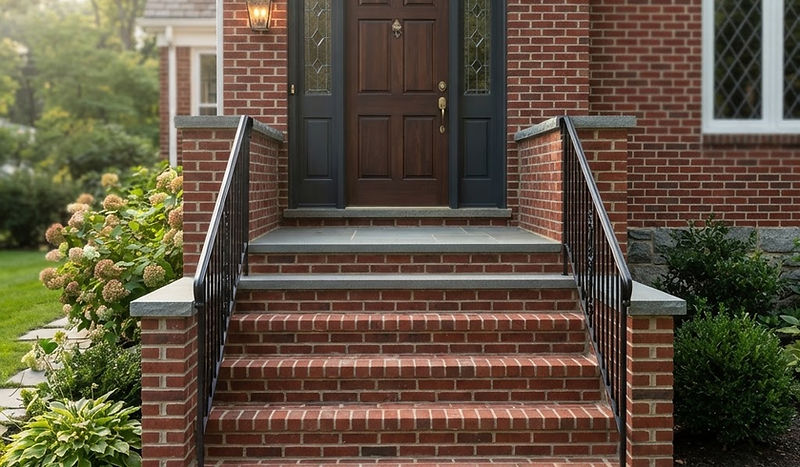
My front steps are pulling away from the house. Can they be repaired, or do they have to be rebuilt?
It depends on how the steps were built. If they were laid on soil or a shallow footing, the fix is a rebuild on a proper concrete footing, which is what lasts. If the masonry itself is sound and only the joints and a few bricks have failed, repointing and selective replacement are the practical answer, and we will tell you plainly which one your stoop needs.
Are paver driveways strong enough for cars and snowplows?
Yes, when they are built as a system rather than a surface: excavated subgrade, compacted gravel base, edge restraint, and joints filled with polymeric sand. We plow our own driveways the same way. A paver driveway also repairs a section at a time after a root or utility dig, which a poured slab cannot.
How do I know if my brick needs pointing or full replacement?
If the brick faces are hard and intact and the problem is crumbling or washed-out mortar, the brick is worth saving and pointing will bring it back. If bricks are flaking, soft or hollow, they have taken on too much water and need to come out. We walk the elevation with you and show you which is which before quoting.
Stone Work & Veneer
Do you do interior work?
Only when it is stone. Interior stone veneer walls, fireplace surrounds, stone columns and bar fronts are all work we do. We are not a kitchen or bathroom remodeling company and we do not install tile, which is why we can tell you exactly how a stone wall should be staged, flashed and finished.
Natural stone veneer or manufactured stone — which should I use?
Natural stone gives you weight, variation and a texture that manufactured profiles cannot fully copy, and it is the choice for a facade you want to look original in thirty years. Manufactured stone installs lighter, costs less, and is the right call for a basement bar or a lower-visibility accent wall. We bring samples of both and price them side by side.
Can you match the stone and mortar already on my house?
In most cases, yes. We take a sample of the existing mortar and stone, match the color and type of mortar, and blend new work into old so a chimney rebuild or an added pier does not read as a patch. Where a stone is no longer quarried, we find the closest available match and show it to you before installing.
Belgian Block & Curbing
How long does a Belgian block driveway last?
Granite block set in a concrete bed on a compacted base will outlast the house. The failures you see on old drives come from too little base, or block laid dry on sand with nothing holding it. We excavate, compact and set the block in concrete so it does not creep, and strike the joints so water runs off rather than sitting in them.
Is Belgian block worth the cost compared to pavers?
It costs more than a standard paver edge because it is real granite and heavier to set, but it is also the part of the driveway that takes the abuse. Many customers run a Belgian block border around a paver field to get the traditional look and hold the edge at the same time, which is a sensible middle ground. We price both so you can choose.
Can you match the block already on my property?
Yes. We match the block size, finish and joint width of the existing curb or border so the new section reads as one continuous line instead of a patch. Older block is often a different nominal size than what is sold today, so we measure what is there first and tell you where a blend will show.
Block Foundations
Do you build new foundations, or only repair them?
Both. We build block and poured foundations for additions, garages and new construction, and we repair existing ones: cracks, bowing walls, crumbling mortar and wet basements. On an addition we can carry the work from the footing and inspection stage straight through the masonry.
My basement wall is bowing inward. Does it have to be replaced?
Usually not. A block wall that has moved under soil pressure can often be anchored back or reinforced instead of torn out, at a fraction of the cost and without disturbing the finish above it. If the block itself has gone soft and crushed, replacing that section is the honest answer. We look at the wall, show you the movement, and tell you which of the two you need before quoting.
How do you stop water coming through the wall?
By finding where it enters. Water at the base of the wall is usually the exterior grade or the drain, and water through the face is usually parging, dampproofing or a failed joint. We check the grade, the gutters and the footing drain before we sell you anything, because pumping sealant into a wall under pressure does not fix the source.
Concrete & Flatwork
Concrete or pavers, which should I choose?
Concrete costs less up front and gives you one seamless surface. Pavers cost more initially, but a section can be lifted and reset if a pipe breaks or a root lifts the base, and they tolerate ground movement without cracking across. For a low-traffic walk, concrete is a sensible choice. For a driveway that gets plowed and salted, plenty of customers prefer pavers or concrete with a properly thickened edge. We quote both so you can weigh it.
Why did my old concrete crack?
Almost always one of four reasons: no control joints or joints in the wrong places, a slab poured too thin, no compacted subbase, or a surface that could not drain. Cracks in a slab that is already failing cannot be cosmetically repaired for long. We show you what caused it, then build the replacement so the same thing does not happen again.
Can you pour concrete in the winter?
Yes, with the right mix, blankets and timing, and it is routine work in New Jersey. What matters is protecting the concrete while it cures rather than pouring and hoping. We watch the forecast and tell you honestly when the window is wrong instead of pouring into a freeze.
Free estimate
Tell us about your project
Fill this in and we will call you to set up a free in-home estimate. If it is easier, just pick up the phone.
- Call or text
- 732-768-5045
- Service area
- Monmouth County, Central New Jersey & surrounding counties